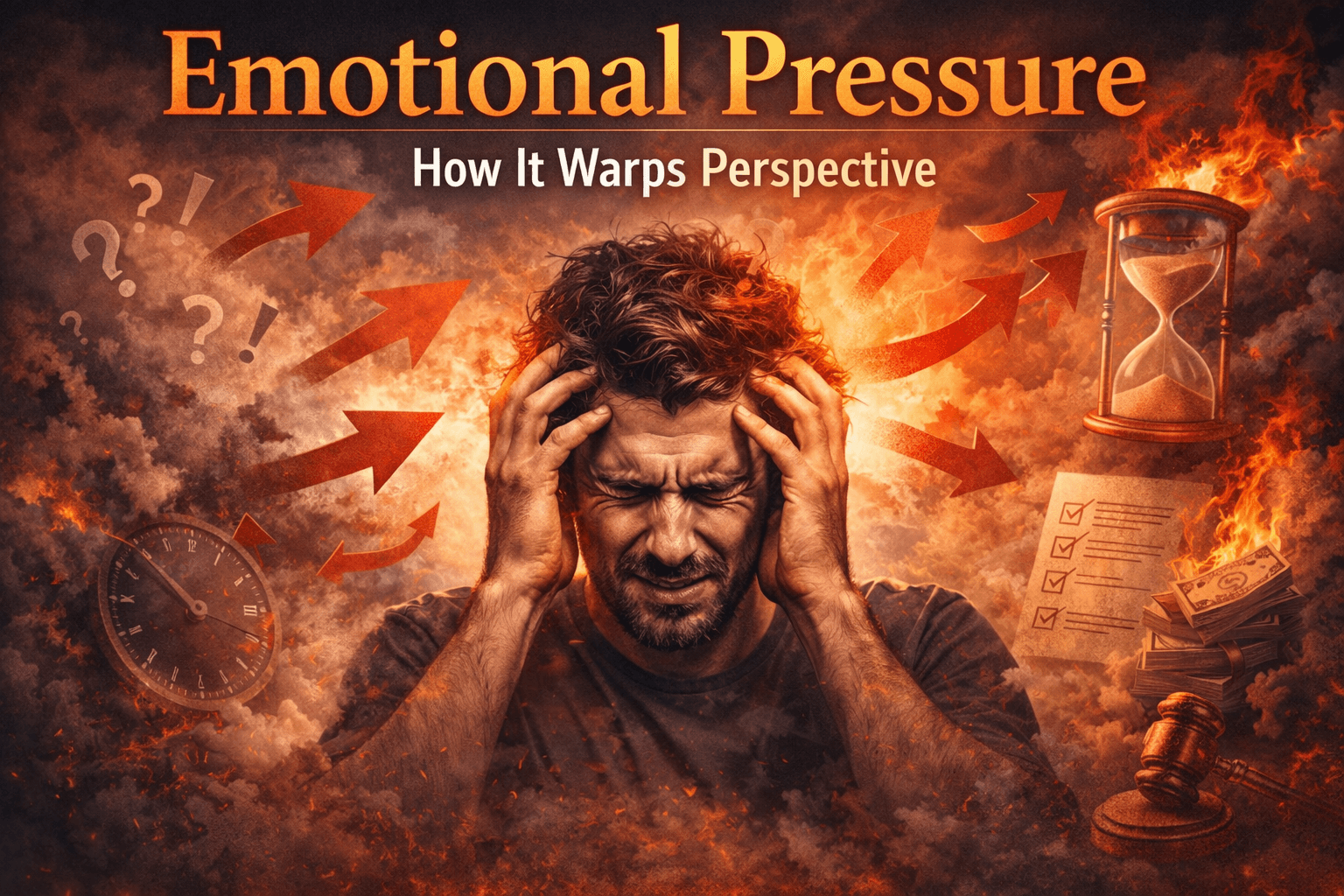
Emotional Pressure operates as a subtle but powerful force, capable of bending our perspective on reality in ways we often only recognize in retrospect. This pressure is not always linked to dramatic external events; it often arises from accumulated minor stressors, internal conflict, or perceived scarcity of time or resources. When the internal environment becomes too loud or dense with worry, the typical mechanisms used for careful assessment and reflection tend to shut down, prioritizing immediate relief or action over reasoned consideration.
Understanding how acute mental strain compromises judgment requires observing the way it interferes with complex thought processes. It does not simply make us feel bad; it structurally alters the way options are weighed, timelines are perceived, and the fundamental value of outcomes is calculated. The process often moves the individual from a state of objective assessment to one of compelled reaction.
—
The Contraction of Cognitive Space
When intense mental strain takes hold, one of the immediate cognitive casualties is the capacity for broad perspective. The field of view contracts sharply, focusing only on the immediate threat or the perceived solution directly in front of us, disregarding the periphery. This narrowing effect makes long-term consequences appear distant, theoretical, and largely irrelevant compared to the crushing urgency of the present moment.
This compression of focus causes a deep reliance on pattern recognition and established routines, even when those patterns are ill-suited to the current context. Instead of analyzing the unique variables of the situation, the pressured mind attempts to categorize the problem quickly to apply a previously successful (or simply familiar) response. This move sacrifices precision for speed.
The mind under duress often seeks certainty above all else, even if that certainty is artificially constructed or deeply flawed. Ambiguity is painful, and emotional pressure amplifies this pain. Consequently, individuals tend to jump toward the first decisive choice that promises to resolve the emotional turbulence, regardless of how robust that decision actually is.
—
The Misalignment of Time and Consequences
A key indicator of judgment compromised by strain is the misalignment of action and consequence over time. The intensity of internal stress creates a psychological present that feels disproportionately important compared to the future. The difficulty lies in the fact that truly dangerous decisions are rarely about immediate physical harm; they are often about long-term, systemic harm that manifests gradually.
For example, a professional under intense deadline pressure might choose a quick, flawed organizational setup that causes substantial remedial work months later. They are addressing the painful present (the deadline) at the expense of creating predictable future pain. The relief of having “done something” momentarily outweighs the eventual, often higher, cost of correction.
This mechanism, while fundamentally protective in genuine survival scenarios, frequently misfires in complex modern life. It causes people to offload current discomfort onto their future selves, prioritizing the immediate emotional stability gained by resolution over the sustained stability that comes from careful, slow construction.
—
Emotional Pressure and the Erosion of Clarity
The primary influence of sustained pressure is the steady erosion of reflective space. True clarity requires time and a degree of internal detachment, both of which are aggressively consumed by intense mental states. Instead of evaluating options based purely on their merits, the mind often cycles through anxieties, confirming pre-existing biases about what must be done, rather than opening up to alternative possibilities.
This compression leads to a situation where the individual is no longer choosing the optimal path, but rather choosing the path of least immediate psychological resistance. This often translates into the fastest way out of the feeling of discomfort or worry, even if it introduces significant, long-term instability into the system being governed. The desire to simply end the painful state of indecision becomes the hidden driving force of the resulting action.
Processing Risk and Volatility
Emotional pressure fundamentally alters how we process risk. When feeling overwhelmed, panicked, or desperate, the objective probability of negative outcomes tends to be severely distorted. Fear often leads to paralyzed inaction, avoiding even necessary, minor risks that would lead to growth, while states like frustration or desperation tend to fuel overconfidence and impulsive leaps into high-stakes situations.
This internal volatility means that the objective facts surrounding a choice become secondary to the dominant internal narrative. Someone making a financially significant choice under severe duress might focus intensely on a small, highly unlikely potential upside, ignoring the high probability of a catastrophic loss, because the pressure demands a rapid, decisive move toward perceived success. The mental escape offered by the potential reward feels more accessible than the slow, steady work required to objectively minimize risk.
—
The Imperative of Non-Reaction
Thoughtful decision-making often involves recognizing that some variables cannot be immediately controlled or known. It requires the capacity to tolerate the anxiety inherent in uncertainty. Emotional pressure inherently rebels against this necessary patience. It demands answers, demands structure, and demands definite outcomes immediately, forcing a premature closure on complex issues that require long marination.
When mental pressure mounts, however, this admission of uncertainty is often perceived not as a fact of reality, but as a personal failure or weakness. This perception triggers a reactive lurch toward the easiest available definition of reality, even if that definition is drastically simplified or based on fragmented information. This tendency to rush toward definition and certainty is frequently what generates decisions that are later deemed dangerous, as they stem from a need to escape emotional discomfort rather than a grounded assessment of facts.
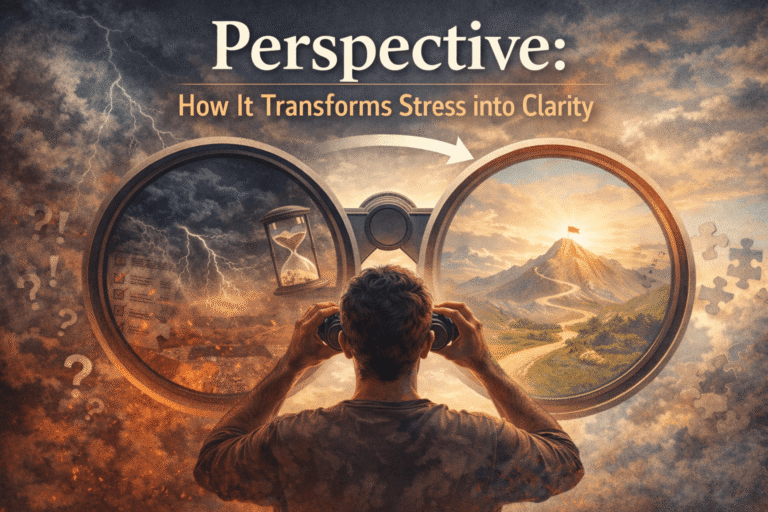
The challenge, therefore, is not necessarily to eliminate the pressure—which is often impossible—but to cultivate a slight distance from it. This distance allows the analytical mind enough room to operate independently from the reactive, urgent emotional state. It shifts the primary focus from reacting to the internal feeling of pressure to objectively observing the context of the external problem. This observation provides the minimal necessary space for clarity to re-emerge, even when the environment remains fundamentally stressful.