
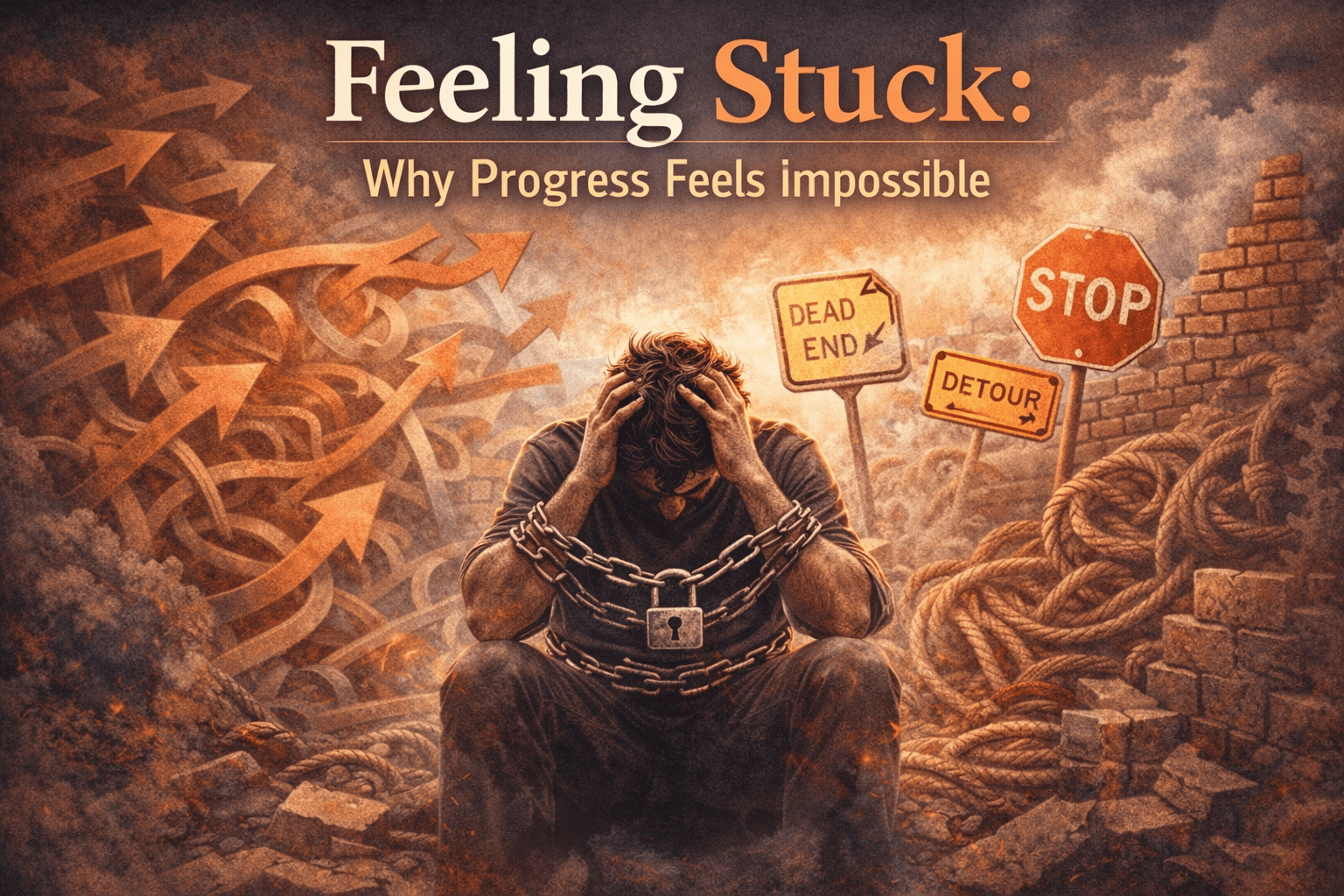
Feeling stuck is perhaps one of the most widely shared human experiences, a condition of profound inertia that seems to defy logic. This state is often characterized less by external barrier and more by an internal jamming mechanism, where movement is desired, but the path forward remains obscured or emotionally inaccessible. It is a moment of necessary pause, though the pause itself may feel frustratingly long and unproductive. Viewing this experience not as failure but as vital information can profoundly alter how the state is managed. The feeling itself serves as an indicator light, drawing attention to aspects of our internal or external architecture that require thoughtful observation.
The Difference Between Inertia and Overload
When a person feels immobile, it is common to assume that a lack of resources or motivation is the primary issue. In many situations, however, the sensation of being jammed arises not from emptiness, but from structural overload. The sheer volume of potential inputs, obligations, and disparate desires can generate a confusing density, making any single action feel insufficient or poorly aimed.
This mental static often leads to a phenomenon known as decision fatigue, where the pressure to select the ‘correct’ next step drains the capacity for meaningful selection. When every available option carries perceived weight or consequence, the safest, simplest immediate action becomes inaction itself. The brain, seeking to conserve energy or avoid error, defaults to a waiting pattern, even if that pattern contradicts the desire for progress.
Interpreting the Friction of Feeling Stuck
The experience of feeling stuck often reveals underlying tensions in our lived experience. It acts like a pressure gauge, showing where current demands exceed present capacity, or where incompatible desires are competing for the same resources. It frequently points toward areas where boundaries have become unclear or where past assumptions no longer align with current reality.
For instance, the immobility may stem from a conflict between external expectations—what one believes they should be doing—and an internal sense of purpose or energy level. If the driving force behind a desired action is purely external validation, the resulting pressure can create resistance strong enough to stop movement entirely. This reflective halt forces a person to examine the source code of their motivation.
Clarity Through Constraint, Not Expansion
A common reaction when encountering this internal friction is to seek external resources or new options, believing that more input will reveal the solution. However, this expansive approach often exacerbates the feeling of being stuck by introducing further complexity into an already congested system. In many contexts, the most helpful path involves deliberate, thoughtful reduction.
Clarity often emerges from the imposition of necessary limits. Instead of asking what else could be done, it can be useful to reflect on what precisely must be excluded or postponed. When the scope of the immediate problem is defined and contained, the mental energy previously spent managing infinite possibilities can be redirected toward fewer, more tangible points of friction. Defining the precise, narrow point of resistance can shift the focus from the overwhelming landscape to a manageable single step.
Navigating Uncertainty and Mental Pressure
The feeling of being stuck is intensely uncomfortable because it clashes with the inherent human desire for predictability and forward momentum. This state often involves a compressed sense of time, where the present paralysis feels like an indefinite sentence. The resulting mental pressure can obscure necessary insights, making the problem feel larger and more intractable than it might appear from a more detached perspective.
It can be helpful to separate the immediate emotional burden from the actual long-term reality of the situation. While the mental experience of being unable to move can be overwhelming in the moment, the objective circumstances rarely change dramatically day to day. Recognizing that movement and clarity often arrive after periods of incubation, rather than instant revelation, can alleviate some of the internal urgency.
The Role of Mental Architecture
The way we structure our internal landscape—how we categorize problems, process information, and manage obligations—significantly influences the frequency and intensity of feeling stalled. A lack of structure tends to blend all concerns into a single, undifferentiated mass. When everything is urgent and important, nothing can be effectively prioritized.
This architecture is not about rigid scheduling, but about creating mental containers. When distinct challenges are separated and given their own defined space, they can often be processed without contaminating neighboring decisions. This separation allows for partial progress in one area, even if another remains intentionally on pause. This approach respects the complexity of life without succumbing to the paralysis of total systems failure.
Reflection as a Mechanism for Unlocking
Ultimately, the phenomenon of feeling stuck serves a crucial reflective function. It is a necessary disruption that prevents continued movement down a path that is fundamentally misaligned or unsustainable. While the experience is characterized by immobility, it requires intense internal activity—not action, but deep analysis of current constraints and values.
The crucial information embedded in this feeling often relates to misalignment: a misalignment between capacity and demand, between ambition and energy, or between short-term needs and long-term intentions. By viewing this state as a protective mechanism—a system waiting for calibration—one can approach the discomfort with a degree of thoughtful patience. It suggests that the path forward requires a refined understanding, not simply greater force. The resolution often lies not in fighting the friction, but in observing exactly where the friction originates.